👟 Training Tip of the Month
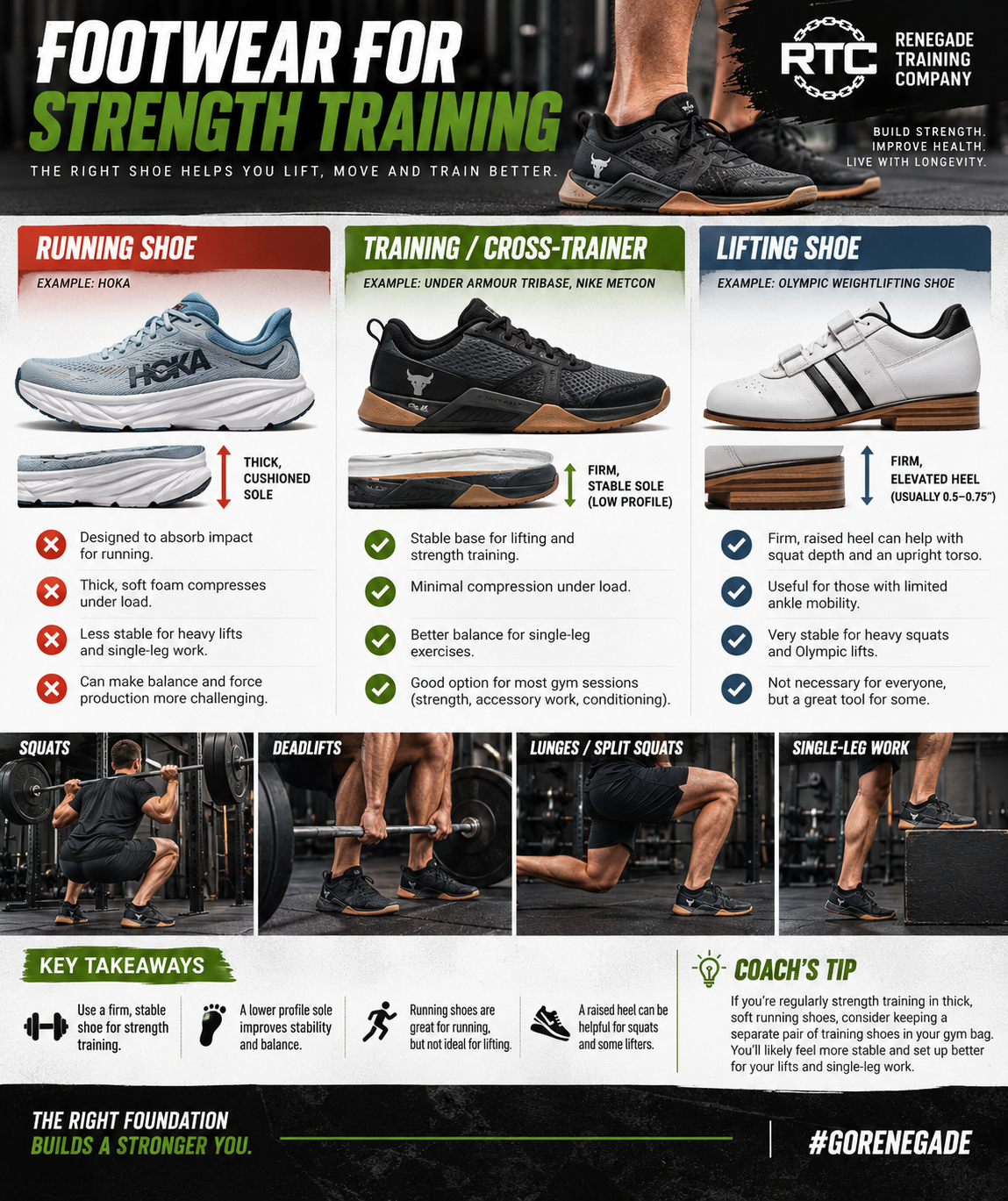
Are Your Shoes Holding Back Your Training?
Why the shoes you wear in the gym matter more than you might think.
One thing we regularly see at Renegade is clients showing up in running shoes for their strength training sessions.
And while running shoes are great for what they're designed to do, they're not always the best choice when it comes to lifting weights.
Many running shoes have thick, soft, cushioned soles designed to absorb impact during running. But when we're strength training, particularly with heavier loads or performing single-leg exercises, we generally want something different.
We want a stable, predictable surface to push against.
💪 Why Footwear Matters for Strength Training
1. Stability & Force Production
Think about performing a heavy squat or deadlift while standing on a thick foam cushion.
As you push into the ground, some of that foam compresses and shifts beneath your feet.
A firmer, more stable sole gives you a more consistent base of support, allowing you to focus on producing force and controlling the movement rather than dealing with unnecessary movement underfoot.
2. Balance & Single-Leg Training
Exercises like split squats, lunges, single-leg RDLs and step-ups challenge your stability.
Adding a thick, soft sole can make that challenge unnecessarily difficult.
A shoe with a firm, relatively low-profile sole can help you maintain a more stable connection with the ground, especially during unilateral exercises.
3. Better Foot Position & Movement
Your feet are your foundation.
A shoe that allows your toes to spread comfortably and provides a secure fit can help you establish a solid base of support.
This is particularly valuable during squats, deadlifts, carries and other loaded movements.
👟 What About Training Barefoot?
For certain exercises, training without shoes can actually be a great option.
Removing thick cushioning allows your feet to make direct contact with the floor, providing sensory feedback and eliminating movement from the shoe itself.
This can be particularly useful for:
Deadlifts and hip hinges
Split squats and lunges
Single-leg balance exercises
Certain squatting variations
However, barefoot training isn't automatically better. Individual foot mechanics, comfort, exercise demands, and facility safety rules all matter.
🏋️ A Little Heel Elevation Can Be a Good Thing!
There's a common misconception that completely flat shoes are always best for lifting.
That's not necessarily true.
For exercises like squats, a firm, slightly elevated heel can be beneficial, particularly for individuals with limited ankle dorsiflexion.
A raised heel can help you achieve greater knee travel and squat depth while maintaining a more upright torso.
This is one reason Olympic weightlifting shoes have firm, elevated heels.
The important distinction is that a solid elevated heel is very different from a soft, compressible running shoe.
🎯 What Should You Look for in a Training Shoe?
Firm, stable sole: Minimal compression under load.
Secure fit: Your foot shouldn't slide around inside the shoe.
Comfortable toe box: Enough room for your toes without excessive movement.
Appropriate heel height: Flat or slightly elevated depending on the exercise and your mechanics.
Good traction: Reliable grip on the training surface.
You don't necessarily need an expensive or specialized lifting shoe. A simple, stable cross-training shoe can be a significant improvement over a highly cushioned runner.
💡 Coach's Tip
If you're regularly strength training in thick, soft running shoes, consider keeping a separate pair of training shoes in your gym bag.
You might be surprised by how much more stable you feel during squats, lunges, deadlifts and other loaded movements.
And remember, the right shoe depends on the task. What works best for heavy lifting might not be what you want for running, jumping or conditioning.
Build your strength from the ground up.
🌮 Recipe of the Month
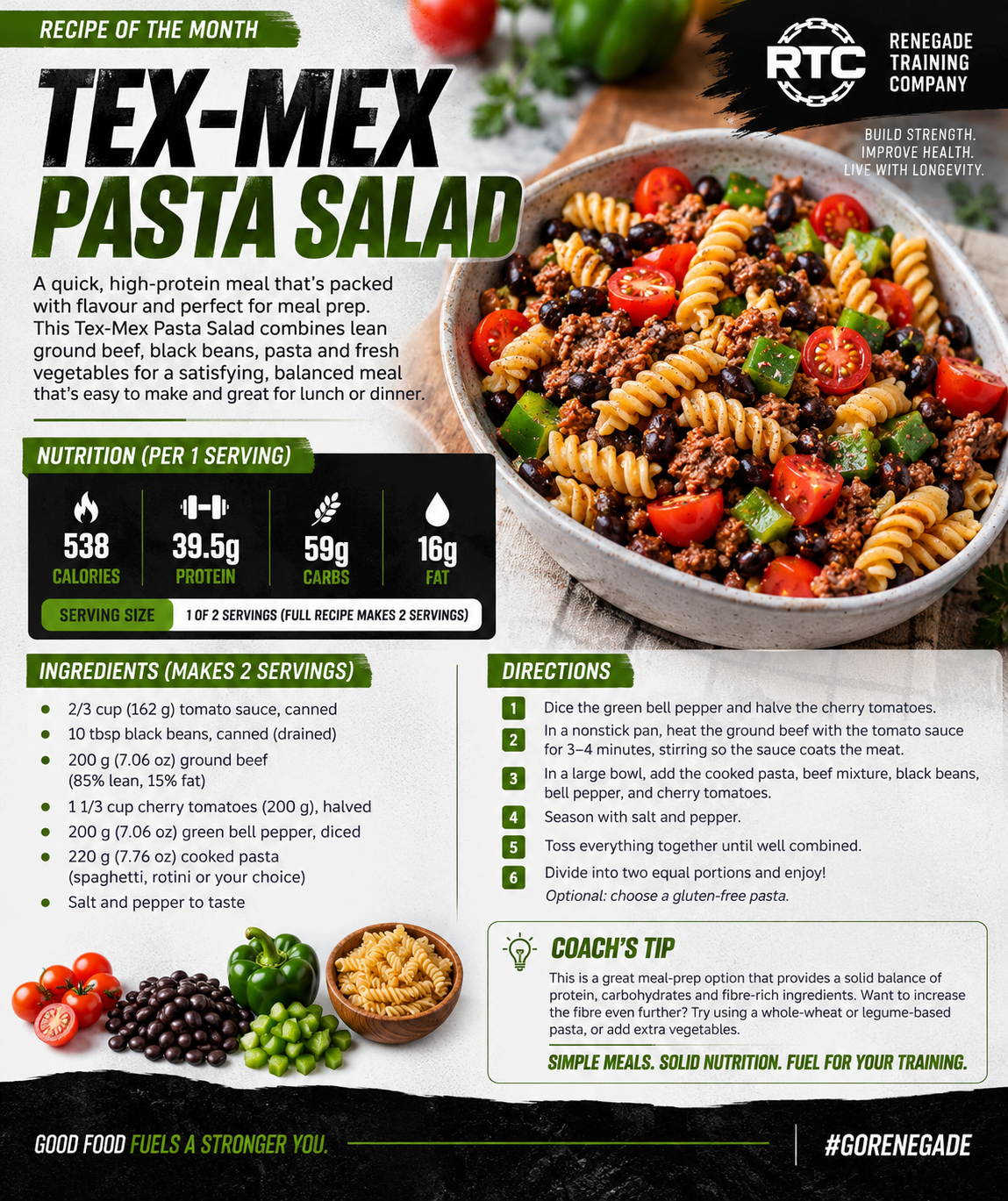
Tex-Mex Pasta Salad
Looking for a quick, protein-packed meal that doesn't require a lot of time in the kitchen?
This Tex-Mex Pasta Salad combines lean ground beef, black beans, pasta and fresh vegetables for a filling, balanced meal that's great for lunch, dinner or meal prep.
With nearly 40g of protein per serving, it's an easy way to support your training and recovery without complicated cooking.
Prep Time: 5 minutes (using pre-cooked beef and pasta) Servings: 2
📊 Nutrition — Per Serving
538 Calories
39.5g Protein
59g Carbohydrates
16g Fat
The full recipe makes 2 servings. Nutrition is calculated for one serving (half the recipe).
🛒 Ingredients — Makes 2 Servings
200g cooked lean ground beef (85% lean)
220g cooked pasta (rotini, spaghetti or your favourite)
10 tbsp canned black beans, drained
200g cherry tomatoes, halved
200g green bell pepper, diced
⅔ cup (162g) canned tomato sauce
Salt and pepper to taste
👨🍳 Directions
Dice the green bell pepper and halve the cherry tomatoes.
In a nonstick pan, heat the cooked ground beef with the tomato sauce for 3–4 minutes, stirring until the beef is evenly coated.
In a large bowl, combine the cooked pasta, beef mixture, black beans, bell pepper and cherry tomatoes.
Season with salt and pepper, toss everything together and divide into two equal portions.
Serve immediately or refrigerate for a convenient meal later.
Optional: Substitute gluten-free pasta if preferred.
💡 Coach's Tip
This is a great meal-prep option because it combines quality protein, carbohydrates and fibre-rich ingredients in one dish.
The beef provides protein to support muscle maintenance and recovery, the pasta supplies carbohydrates to fuel training, and the black beans and vegetables contribute fibre and micronutrients.
Want to increase the fibre even further? Try whole-wheat or legume-based pasta.
Simple meals. Solid nutrition. Consistency that supports your training. 💚
#GoRenegade
📅 What's Happening
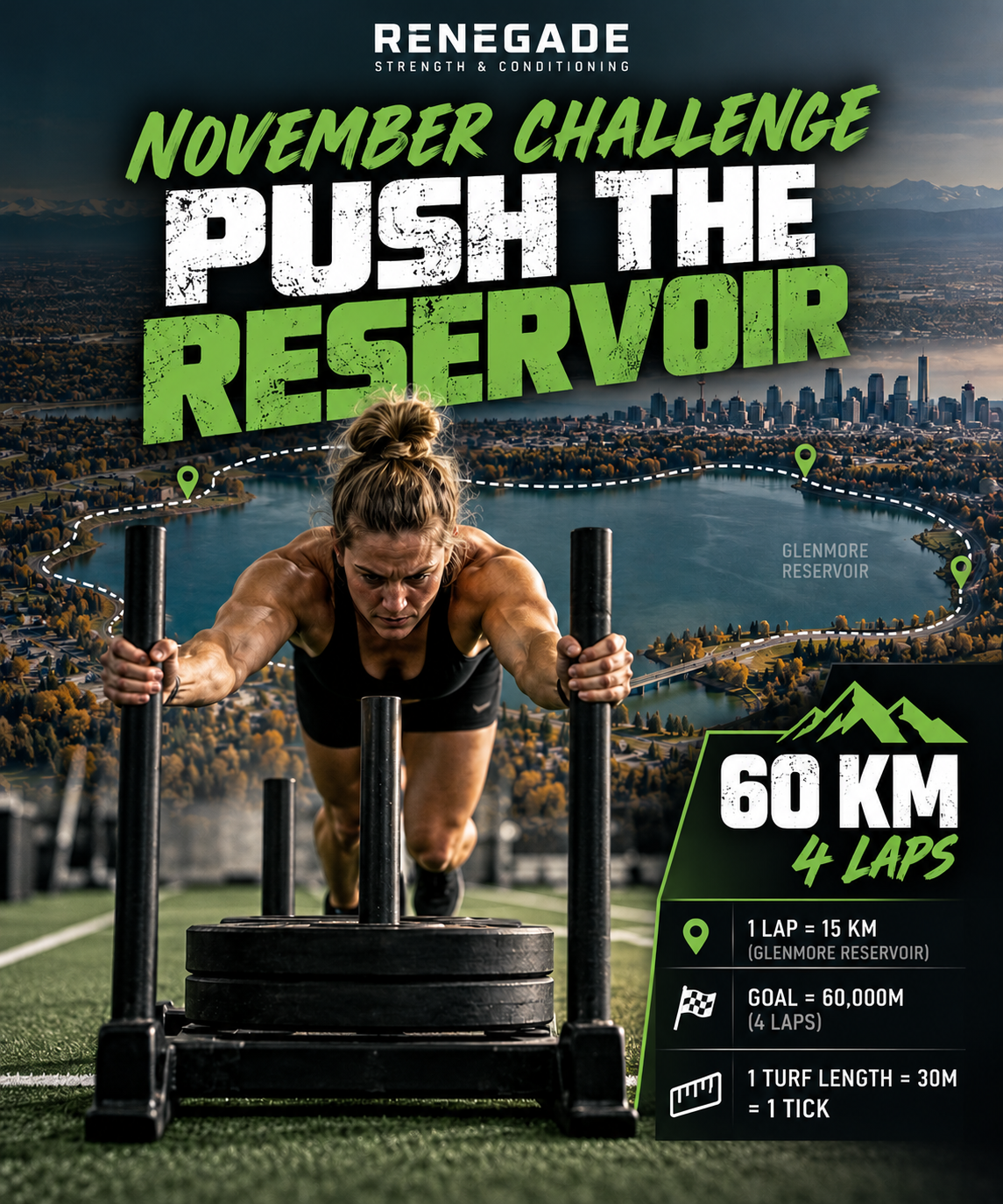
🏔️ NOVEMBER CHALLENGE: PUSH THE RESERVOIR! 💪🔥
Last month we carried ourselves to Banff and back. This month, we're putting those legs to work and pushing our way around Calgary's Glenmore Reservoir!
🎯 THE GOAL: 60,000 METRES (60 KM)
One lap around the Glenmore Reservoir is approximately 15 km, and we're aiming to complete 4 FULL LAPS as a gym!
HOW IT WORKS 👇
🛷 Grab a sled and get pushing! No additional weight is required. Pick a sled appropriate to your experience.
📏 One length of the turf (line to line) = 30 METRES = 1 TICK
🔥 Sled pushes during your regular workouts count! Want to contribute more? Knock out some extra lengths before or after training.
📝 Add your ticks to the whiteboard and watch our gym total climb throughout November!
THE TARGET:
🏁 15,000m = 1 Lap
🏁 30,000m = 2 Laps
🏁 45,000m = 3 Laps
🏁 60,000m = 4 Laps!
That's 2,000 LENGTHS OF THE TURF we're chasing together! 😳
Every push counts. Every metre matters. Whether you're contributing 30m or 3,000m, we're all working toward the same goal.
60 KM. 2,000 PUSHES. ONE GYM.
Let's see how many times we can make it around the reservoir! 💪🔥